
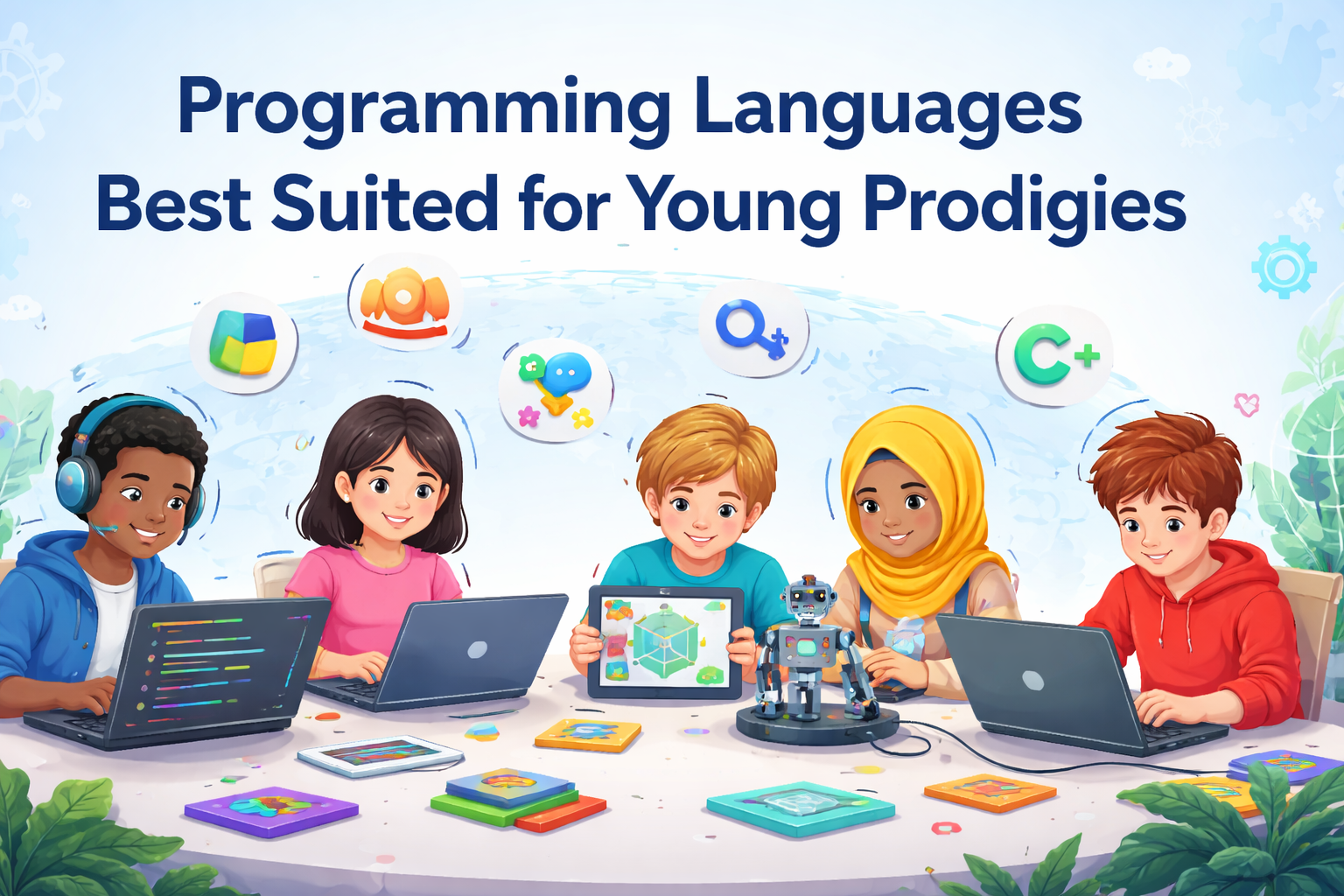
Programming has become a universal skill, relevant across countries, cultures, and education systems. For young prodigies—children who display exceptional ability in logical reasoning, pattern recognition, and problem-solving—early exposure to programming can help channel curiosity into structured thinking and meaningful creation. However, the effectiveness of this journey depends greatly on which programming languages are introduced and when.
Rather than focusing on speed or complexity, the goal for young prodigies should be clarity, depth of understanding, and sustainable growth. Programming languages are learning tools, and when chosen thoughtfully, they support intellectual development without unnecessary pressure.

The Role of Programming Languages in Early Talent Development
A programming language influences how a child approaches problems. For young learners with high potential, a suitable language should:
- Be readable and intuitive
- Reduce frustration caused by syntax complexity
- Encourage experimentation and logical reasoning
- Allow progression from simple ideas to advanced concepts
Globally, education systems and learning platforms increasingly emphasize conceptual understanding over rote learning, especially for gifted children. Programming languages that align with this philosophy are more effective in nurturing young prodigies.
Scratch: Developing Computational Thinking First
Scratch, developed by the MIT Media Lab, is widely used across the world as an introductory programming environment for children.
Scratch uses visual blocks instead of written code. This design helps children understand core concepts such as sequencing, loops, conditionals, and events without worrying about syntax errors. For young prodigies, this is particularly valuable because it allows them to grasp abstract ideas quickly and apply them creatively.
Scratch is not intended to be a long-term programming language, but it plays an important role in building strong mental models of how programs work. Many educators view it as a conceptual foundation rather than a technical endpoint.
Python: A Balance of Simplicity and Depth
Python is one of the most widely recommended programming languages in education worldwide. Its syntax is clean and readable, making it accessible even to children whose first language is not English.
Python allows young prodigies to focus on logic and problem-solving rather than memorizing complex syntax. It is commonly used in schools, universities, and research environments, which makes it a strong bridge between early learning and advanced study.
Key reasons Python works well for young prodigies include:
- Clear, minimal syntax
- Immediate feedback when running programs
- Applicability in mathematics, science, and data analysis
- Availability of extensive learning resources
Because Python scales well from beginner-level projects to advanced applications, it supports long-term development without forcing early specialization.
JavaScript: Learning Through Interaction and Creativity
JavaScript is central to web development and is often introduced when learners want to build interactive projects.
Unlike many traditional languages, JavaScript allows children to see results immediately in a web browser. This visual feedback can be highly motivating for young prodigies, especially those who enjoy creativity alongside logic.
From an educational perspective, JavaScript helps learners:
- Understand how users interact with software
- Combine logic with design and structure
- Build projects that can be shared easily across borders
JavaScript is especially relevant in a global context, as the web is a shared platform accessible almost everywhere. With appropriate guidance, it can be a powerful tool for applied learning.

Java: Structured Thinking and Long-Term Foundations
Java is commonly used in formal computer science education and is known for its structured, object-oriented approach.
For young prodigies who are ready to handle more complexity, Java introduces important ideas such as classes, objects, and modular design. These concepts help learners understand how large software systems are built and maintained.
Java encourages discipline and planning, which can be beneficial for older prodigies transitioning from exploratory learning to structured problem-solving. It is widely used across industries and educational institutions, making it a relevant choice for long-term skill development.
C++: Advanced Logical and System-Level Understanding
C++ is typically introduced at a more advanced stage due to its complexity. It requires careful attention to detail and a strong understanding of programming fundamentals.
In educational settings, C++ is often used to teach:
- Algorithmic efficiency
- Memory and performance concepts
- Precise logical reasoning
For young prodigies with a strong interest in mathematics or computer science theory, C++ can deepen understanding of how software interacts with hardware. However, it is most effective when introduced gradually and with proper support.
Mobile Development Languages: Swift and Kotlin
As mobile technology plays a central role in daily life worldwide, many young learners are drawn to app development.
- Swift is used for iOS applications
- Kotlin is widely adopted for Android development
Both languages emphasize modern programming practices and safety. They allow young prodigies to create applications with practical relevance, helping them see how programming can be used to address real-world needs.
Progression Matters More Than Quantity
A common misconception is that prodigies should learn many languages as early as possible. In practice, depth of understanding is far more important than the number of languages learned.
A thoughtful progression often looks like:
- Conceptual learning with visual tools
- General-purpose problem-solving with readable languages
- Applied development through web or mobile projects
- Structured and advanced learning when readiness is evident
This approach supports both intellectual growth and well-being.
Globally Recognized Educational References
The principles discussed here are supported by guidance and research from internationally respected organizations, including:
- Scratch Foundation
- Harvard University computer science education initiatives
- UNESCO frameworks on digital literacy
- OECD education and skills reports
These sources emphasize accessibility, progression, and responsible use of technology in education.
At GCPA, we believe that every child with talent deserves the opportunity to grow in an environment that values learning, balance, and inclusion. Programming languages are not measures of intelligence, but tools that can help young minds express ideas, solve problems, and build confidence. By focusing on the right foundations and supporting children at their own pace, we aim to encourage growth that is meaningful, ethical, and accessible to young prodigies across the world.